A business posts two ads on a social media platform. In one day, the first ad is viewed by 100 unique accounts and the second ad is viewed by 200 unique accounts. The Account Reach for that day is 300 unique accounts reached.
Account Reach
Last updated: May 29, 2026
What is Account Reach?
Account Reach is the total number of unique accounts that have viewed posts or ads published by a business account on social media. Repeat views are not counted — each account is counted once, regardless of how many times that account views the content.
Account Reach Formula
ƒ Count(Unique Accounts That Viewed Content)
How to calculate Account Reach
Start tracking your Account Reach data
Use PowerMetrics, modern analytics platform, to monitor your data. Choose a service below to start tracking your Account Reach instantly.

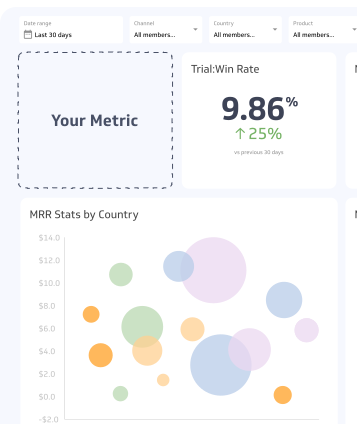
How to visualize Account Reach?
Use a summary chart to best visualize your Account Reach data. This type of chart compares the current Account Reach to a previous time period.
Account Reach visualization example

Summary Chart
Here's an example of how to visualize your current Account Reach data in comparison to a previous time period or date range.

Account Reach
Chart
Measuring Account ReachMore about Account Reach
Account Reach measures how many distinct accounts have seen your content — whether organic posts or paid ads — on a social media platform. Each account is counted once, regardless of how many times that account views the content.
This makes Account Reach a measure of audience breadth: how far your content has spread across unique viewers.
Account reach vs. account impressions
Account Reach is often tracked alongside Account Impressions, but the two metrics measure different things.
| Metric | What it counts |
|---|---|
| Account Reach | Unique accounts that viewed the content |
| Account Impressions | Total views, including repeat views by the same account |
If one account views your post three times, that contributes 1 to Account Reach and 3 to Account Impressions. Use both metrics together to understand how broadly your content spread and how frequently it was seen.
Why account reach matters
Account Reach tells you how many people your content actually reached — not just how many times it was displayed. This makes it useful for evaluating the scale of your content distribution and the potential size of your engaged audience.
When tracked alongside engagement metrics such as Post Likes, Post Comments, and Post Shares, Account Reach helps you assess whether your content is connecting with a broad audience or circulating within a narrow group.
It also connects directly to content engagement strategy: a high reach with low engagement may signal that content is visible but not resonating, while a lower reach with strong engagement may indicate a loyal but limited audience.
What affects account reach?
Platform algorithms play a significant role in determining Account Reach. Most social media platforms use engagement signals — likes, comments, shares, saves — to decide how often and to whom your content appears in feeds.
When users interact with your content regularly, the platform is more likely to show your posts to those users again and to surface your content to new accounts. This creates a compounding effect: stronger engagement tends to expand reach over time.
Posting frequency, content format, and timing also influence how many unique accounts see your content on any given day.
How to use account reach effectively
Account Reach is most useful when tracked over time and in context with other metrics. A few practical approaches:
- Compare reach across content types. If video posts consistently reach more accounts than static images, that signals a format preference in your audience.
- Monitor reach relative to follower count. A high ratio suggests strong organic distribution; a low ratio may indicate your content is not being surfaced widely.
- Use reach to evaluate paid vs. organic performance. Separating ad reach from organic reach helps clarify where your audience growth is coming from.
- Track reach alongside engagement rate. Reach tells you the size of your potential audience; engagement rate tells you how that audience responded.
Contributor