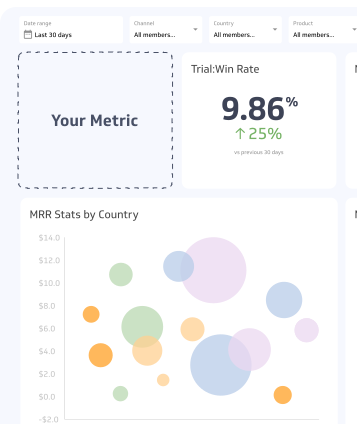
Revenue growth rate should be interpreted differently based on company maturity, and when properly segmented and contextualized, provides critical insights that make this metric truly actionable for strategic decision-making. Let's break this down in more detail:
Early-Stage Companies
Early-stage companies are typically pre-revenue or have just started generating significant revenue. At this phase:
- High Growth Expectations (30-100%+ annually): These aggressive targets reflect the exponential growth pattern of successful startups. For venture-backed companies especially, investors expect these high rates because they've provided capital specifically to fuel rapid expansion rather than profitability.
- Market Validation: Strong revenue growth at this stage is less about financial performance and more about proving product-market fit. It demonstrates that customers are willing to pay for your solution and that your value proposition resonates in the market.
- Volatility is Normal: Early-stage revenue often comes in large, irregular chunks (like landing a significant client) rather than steady streams. Month-to-month or quarter-to-quarter fluctuations of 50%+ are common and shouldn't cause panic.
- Context is Critical: A 100% annual growth rate sounds impressive, but if it requires burning through venture capital at an unsustainable rate, it may indicate poor unit economics. Always compare growth to cash burn and fundraising timelines.
Growth-Stage Companies
At this middle stage, companies have established product-market fit and are scaling operations:
- Sustainable Growth (20-50% annually): Growth rates naturally moderate but should remain robust. The focus shifts from "growth at all costs" to "efficient growth."
- Operational Efficiency: The key tension becomes balancing continued growth with improving unit economics. Finance teams should track metrics like CAC payback period and contribution margin to ensure growth is sustainable.
- Predictability Matters: As your company matures, investors and board members expect more accurate forecasting. Being able to predict revenue within 5-10% of actuals builds credibility with stakeholders.
- Segment Analysis: Overall growth might mask important trends. One product line might be growing 80% while another is declining 20%. Breaking down growth by segment reveals strategic opportunities and risks.
Mature Companies
Established companies with significant market share face different growth challenges:
- Targeted Growth: Rather than broad-based growth, mature companies typically find success by identifying specific high-potential segments (whether geographical, demographic, or use-case based).
- Market Performance: While startups might get away with "growth is good," mature companies need to benchmark against their industry. Growing at 15% annually is impressive in manufacturing but concerning in SaaS.
- Quality of Revenue: Not all revenue is equal. Mature companies should prioritize recurring, high-margin revenue over one-time, low-margin revenue, even if the latter offers higher nominal growth.
- Reinvention Strategies: Many mature companies eventually face growth plateaus in their core business. Successful ones develop adjacent products or enter new markets to maintain momentum (think Apple moving from computers to phones to services).
Contextual Metrics
Revenue growth never tells the complete story in isolation. These complementary metrics provide crucial context:
- Gross Margin Trend: If revenue is growing 30% but gross margins are declining from 70% to 50%, you're likely discounting heavily or taking on less profitable business to achieve growth.
- CAC: If you're spending $1.50 to acquire each $1.00 of new annual revenue, growth may not be sustainable without additional capital.
- Retention Rates: "Leaky bucket" growth (high acquisition but poor retention) is much less valuable than growth built on expanding existing customer relationships.
- Market and Competitive Growth: If your market is growing at 25% and you're growing at 20%, you're actually losing market share despite posting impressive absolute numbers.
Strategic Implications and Pitfalls
The pattern of your growth rate over time reveals important strategic insights:
- Acceleration vs. Deceleration: An acceleration in growth rate often indicates reaching a tipping point in market adoption, while deceleration might signal market saturation.
- Negative Growth: Requires immediate intervention – either cost-cutting to maintain profitability or strategic repositioning.
- Vanity Growth: Growing through deep discounts or unprofitable terms might look good for a quarter but destroys long-term value.
- Ignoring Segmentation: If you're only looking at total company growth, you might miss that your core product is declining while a small new product is masking that decline with explosive growth.
The key takeaway for any finance professional is that revenue growth rate isn't just a number to report – it's a strategic compass that should guide resource allocation, identify emerging opportunities, and reveal potential threats before they become crises.
