EBITDA Margin is a financial ratio that measures a company's earnings before deducting non-operating expenses as a percentage of revenue. The calculation excludes accounting expenses such as interest, taxes, depreciation, and amortization to give an overall view of operating profitability and cash flow generation capability.
A company that generates $500,000 revenue in one year has an EBITDA of $300,000. Therefore, the EBITDA Margin for that year is 60%.
Calculation: $300,000 ÷ $500,000 × 100% = 60%
To derive EBITDA from financial statements:
Start with Net Income: $200,000
Add back Interest: $30,000
Add back Taxes: $20,000
Add back Depreciation: $40,000
Add back Amortization: $10,000
EBITDA = $300,000
EBITDA Margin varies significantly by industry due to different cost structures and capital intensity:
Software/SaaS: 15-25% is average, with top performers reaching 30-40%
Manufacturing: 10-15% is typical, with mature businesses reaching 15-20%
Retail: 5-10% is common, with luxury brands achieving 15-20%
Telecommunications: 30-45% is standard due to high infrastructure investments
Utilities: 35-50% due to regulated pricing and high capital expenditures
Healthcare services: 15-25% is typical
Restaurants: 10-20% with fast-casual chains on the higher end
Professional services: 15-25% with economies of scale at larger firms
EBITDA Margin by Company Stage:
Early-stage growth companies: May have negative or low margins (0-10%) as they focus on growth over profitability
Scale-up phase: Typically see expanding margins (10-20%) as operational efficiencies emerge
Mature companies: Generally higher and stable margins (20%+) as operations are optimized
Declining businesses: Often show temporarily elevated margins as investments and maintenance are reduced
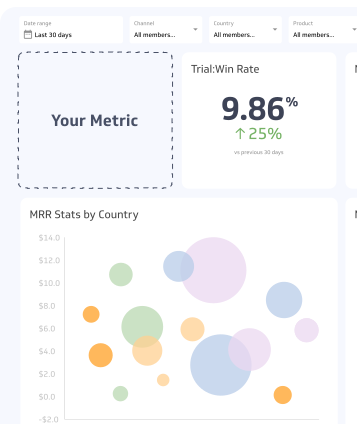
When visualizing your EBITDA Margin, it is optimal to view this number as a summary chart, comparing current values to the past.
EBITDA is an acronym for Earnings Before Interest, Taxes, Depreciation, and Amortization. Companies calculate EBITDA to know how much net income is generated after operating expenses, but before non-operating expenses and non-cash charges. EBITDA Margin is derived from EBITDA, and calculates EBITDA as a percentage of total revenue. This ratio describes operational profitability and operating expense management.
This ratio is useful because it focuses mainly on expenses that can be actively managed by a company directly such as reducing manufacturing costs or implementing automation. It also provides an effective way to compare companies of various sizes by showing how well a company is managing its operating costs regardless of size. Additionally, EBITDA Margin neutralizes the effects of different capital structures, tax jurisdictions, and asset depreciation policies, enabling more standardized comparisons across companies and industries.
Limitations and Considerations
Investors and analysts must be careful when tracking EBITDA Margin because it tends to be higher than other financial ratios and can hide financial problems by making a company seem more profitable than it really is. It excludes capital expenditures and working capital needs, which are real cash requirements for most businesses. Knowing your EBITDA margin allows you to understand your operating leverage as well.
EBITDA is not recognized under Generally Accepted Accounting Principles (GAAP) or International Financial Reporting Standards (IFRS), so calculation methods may vary between companies. Always check how a specific company calculates their EBITDA for accurate comparisons.