Your call centre received 50 support tickets in one month. Your team responded to every ticket, spending a combined 3,000 minutes on first replies. First Response Time = 3,000 minutes / 50 tickets = 60 minutes. That means customers waited an average of one hour before hearing back from your team.
First Response Time (FRT)
Last updated: Jul 07, 2026
What is First Response Time?
First Response Time (FRT) is the average time an agent takes to send an initial reply to a customer support ticket or inquiry. It measures the gap between when a customer submits a request and when your team first acknowledges it — a direct signal of support team availability and operational maturity.
Alternate names: First Reply TimeFirst Response Time Formula
ƒ Sum(Time taken to send a first response
Description: First Response Time (FRT) is the average time an agent takes to send an initial reply to a customer support ticket or inquiry. It measures the gap between when a customer submits a request and when your team first acknowledges it — a direct signal of support team availability and operational maturity.
) / Count(Customer issues that received a first response)How to calculate First Response Time
Start tracking your First Response Time data
Use PowerMetrics, modern analytics platform, to monitor your data. Choose a service below to start tracking your First Response Time instantly.

What is a good First Response Time benchmark?
Benchmarks vary by support channel. For phone support, under 3 minutes is considered good. For live chat, under 1.5 minutes. For email and ticketing systems, most customers expect a first response within 24 hours. Targets should reflect your industry, customer tier, and any SLA commitments.
How to visualize First Response Time?
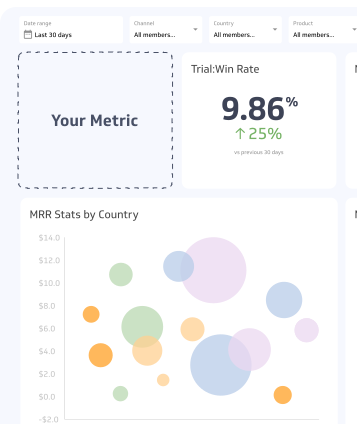
Use a summary chart to display your current First Response Time and compare it to a previous time period.
First Response Time visualization example

Summary Chart
Here's an example of how to visualize your current First Response Time data in comparison to a previous time period or date range.

First Response Time
Chart
Measuring First Response TimeMore about First Response Time
Why First Response Time matters
FRT is one of the most visible signals of your support team's reliability. A fast acknowledgement — even before a resolution is available — tells customers their request has been received and is being worked on. A slow one signals neglect, even if the eventual answer is excellent.
Research consistently shows that customers are more likely to share a negative support experience than a positive one. A slow FRT inflates the initial frustration, often leading customers to submit duplicate tickets, escalate through other channels, or leave publicly visible feedback.
Mapping FRT against Net Promoter Score (NPS) or post-ticket satisfaction surveys can reveal how wait times influence customer loyalty and downstream behaviour like renewals and expansion revenue.
FRT as an operational health indicator
FRT is a leading indicator of how well your support operation scales. When ticket volume spikes — during a product outage, a marketing campaign, or a seasonal rush — FRT is often the first metric to slip.
Monitoring FRT closely helps you spot capacity problems before they compound. Understanding how holidays, product releases, and unexpected incidents affect your FRT lets you plan staffing and routing more effectively. The goal is a consistent FRT — one that sets clear expectations for both customers and agents.
How to improve First Response Time
A few targeted practices can move FRT meaningfully without burning out your team.
Set clear internal targets. Agents need to know what the FRT target is and how performance is measured. Without a defined benchmark, FRT becomes inconsistent across the team.
Acknowledge first, resolve second. Even when an agent doesn't have an answer yet, a brief acknowledgement — "We've received your request and are looking into it" — resets the customer's anxiety and stops the FRT clock. A customer who has been acknowledged is a calmer customer.
Use routing and prioritization. Tickets routed to the wrong queue or sitting unassigned inflate FRT artificially. Automated routing rules based on ticket type, channel, or customer tier reduce queue time significantly.
Monitor volume patterns. Identify when your team is most likely to fall behind — Monday mornings, post-release days, holiday periods — and adjust staffing accordingly.
Track FRT by channel. Aggregating FRT across email, chat, and phone can obscure problems. A strong phone FRT can hide a poor email FRT. Break the metric down by channel for an accurate picture.
First Response Time vs. related metrics
FRT is one of several time-based support metrics. Knowing where it fits helps you use it correctly.
| Metric | What it measures |
|---|---|
| First Response Time | Time from ticket submission to first agent reply |
| Average Handle Time | Total time spent actively working a ticket |
| Time to Resolution | Total time from ticket open to ticket closed |
| First Contact Resolution | Whether an issue is resolved in a single interaction |
FRT is a lagging indicator of your team's availability and routing efficiency, and a leading indicator of customer satisfaction. Tracking it alongside Time to Resolution and First Contact Resolution gives you a fuller picture of support quality.
Common measurement pitfalls
Business hours vs. clock hours. Some teams measure FRT in business hours; others use calendar hours. The difference matters significantly for tickets submitted on weekends or after hours. Be consistent and document your methodology.
Excluding unresponded tickets. If tickets that never received a response are excluded from the calculation, your FRT will look better than it is. Include all tickets — or track the unresponded rate separately — to avoid a misleading picture.
Conflating acknowledgement with resolution. FRT measures the first reply, not the answer. A fast FRT paired with a slow resolution can still produce a frustrated customer. Use FRT alongside Time to Resolution to get the full story.
Metrics related to First Response Time
Comparisons
Average Speed to Answer (ASA) vs First Response Time (FRT)First Response Time vs. Full Resolution Time