
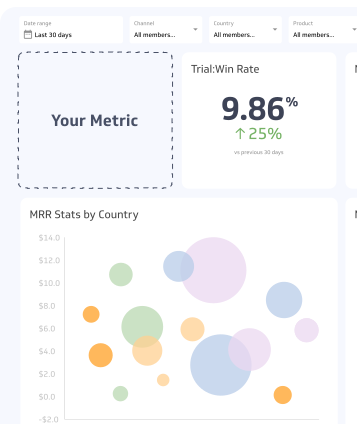
Average purchase revenue serves as a vital barometer for the financial performance of any business with a direct sales component, such as an e-commerce store or an app with in-app purchases. It moves beyond simple sales volume by focusing on the value of each individual sale. A higher average purchase revenue suggests that customers are either buying more products per transaction, purchasing higher-priced items, or responding well to upselling and cross-selling initiatives. Conversely, a decline in this metric could indicate a shift in customer behaviour towards lower-cost items or a lack of effectiveness in promotional offers.
This metric is most powerful when analyzed in a broader context. For example, comparing average purchase revenue across different customer segments or marketing channels can reveal which groups or acquisition methods are driving the most profitable sales. A marketing channel that generates a high volume of traffic and transactions but a low average purchase revenue may require a different strategic approach than a channel that brings in fewer transactions with a significantly higher average value. Tracking this metric over time also allows businesses to identify long-term trends, such as seasonal purchasing habits, and to measure the impact of major business decisions like a new product launch or a price adjustment.
While often used interchangeably with Average Order Value (AOV), the term Average Purchase Revenue has a specific, technical definition within the realm of Google Analytics 4 (GA4). In GA4, this metric is a precise calculation of total purchase revenue—including revenue from e-commerce, in-app purchases, and subscriptions, with refunds subtracted—divided by the total number of transactions. This specific definition in GA4 makes it a valuable metric for users of that platform to track the direct financial results of their online efforts. While not a standard pre-built report metric in GA4, it can be accessed and analyzed through the Explore section, where it can be combined with various dimensions to uncover deep insights.
Analysing average purchase revenue by product category or geographic location can also provide actionable intelligence. For instance, if a specific region or product line consistently has a lower average purchase revenue, a business might need to adjust its pricing strategy, offer targeted promotions, or re-evaluate its product mix for that market. This level of granularity helps businesses to move beyond a high-level view and make targeted improvements that can significantly impact their bottom line. It's important to remember that this metric should not be viewed in isolation. It is a powerful piece of the puzzle, but for a complete picture, it must be considered alongside other metrics like customer lifetime value and customer acquisition cost to ensure a sustainable and profitable business model.
