A company sells a cloud storage platform with an annual contract value of $13,000. Through market research, the team identifies 400,000 companies as potential customers. TAM = 400,000 × $13,000 = $5.2 billion. This figure represents the theoretical market ceiling, not a revenue target.
Total Addressable Market (TAM)
Last updated: Aug 02, 2026
What is Total Addressable Market?
Total Addressable Market (TAM) is a measure of the maximum revenue opportunity available if a product or service captured 100% of its target market.
Alternate names: Total Available MarketTotal Addressable Market Formula
ƒ Count(Total Number of Potential Customers) * Sum(Annual Contract Value)
How to calculate Total Addressable Market
Start tracking your Total Addressable Market data
Build and track this metric in PowerMetrics, a modern analytics platform that lets you define metrics and connect your own data.
Get PowerMetrics Free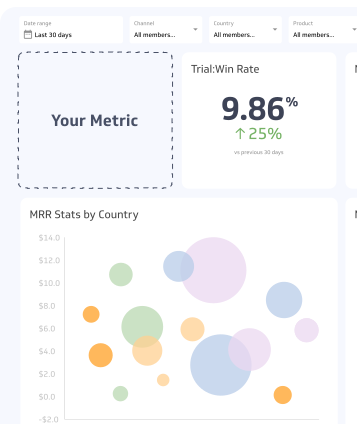
What is a good Total Addressable Market benchmark?
A larger TAM generally signals a more attractive market opportunity. Venture capital firms typically look for markets with a TAM in the billions when evaluating early-stage investments, since even a small share of a large market can produce significant returns. There is no universal TAM threshold that defines a viable market — context, competitive density, and margin profile all factor into the assessment.
How to visualize Total Addressable Market?
TAM is a generally high-level metric giving you information about your potential market share, and is best visualized with a summary chart.
Total Addressable Market visualization example

Summary Chart
Here's an example of how to visualize your current Total Addressable Market data in comparison to a previous time period or date range.

Total Addressable Market
Chart
Measuring Total Addressable MarketMore about Total Addressable Market
TAM is the starting point for any serious market sizing exercise. Calculating it before entering or expanding into a market helps teams understand the upper boundary of the opportunity and decide whether the effort is worth pursuing.
Since no company captures 100% of any market, TAM functions as a ceiling rather than a target. Pairing it with SAM and SOM produces a more realistic picture of what is actually achievable.
Three methods for calculating TAM
No single calculation method suits every situation. The right approach depends on available data and the precision required.
Top-down approach
Start with broad industry research from firms such as Gartner or IDC, then apply assumptions to estimate your slice of the market. This method is fast but relies heavily on estimation. Use it for early-stage sizing, not detailed investment analysis.
Bottom-up approach
Identify specific market segments you can serve, count potential customers within each, and multiply by your price point. This produces a more grounded estimate because it builds from actual sales data or direct market research rather than industry aggregates.
Value theory approach
Estimate what customers would pay for your product based on the value it delivers, compared to substitute or adjacent products. This method works well for new product categories where comparable market data is limited.
TAM, SAM, and SOM
TAM is the first layer in a three-part market sizing framework:
| Term | Full name | What it measures |
|---|---|---|
| TAM | Total Addressable Market | The full revenue opportunity if you captured 100% of the market |
| SAM | Serviceable Available Market | The portion of TAM your product and distribution can realistically serve |
| SOM | Serviceable Obtainable Market | The realistic market share you can capture given competition and constraints |
A complete market analysis covers all three. TAM without SAM and SOM can create misleading optimism about a market opportunity.
Why TAM matters
TAM anchors strategic decisions across product, sales, and finance teams. A well-calculated TAM helps answer whether a market is worth entering, how to prioritize segments, and what the growth ceiling looks like. Investors and boards use TAM to assess whether a business can scale to the size they require.
Common challenges and limitations
TAM is not a revenue forecast. Treating TAM as an achievable target is a common mistake. It defines the ceiling, not the expectation.
Data quality affects accuracy. Top-down estimates depend on the quality of third-party research. Outdated or overly broad industry reports can inflate or deflate the number significantly.
Market boundaries shift. TAM is a point-in-time estimate. New competitors, technology changes, and regulatory shifts can expand or contract the addressable market quickly. Recalculate TAM regularly rather than treating it as fixed.
Segmentation matters. A single TAM figure for a large, heterogeneous market can obscure meaningful differences between segments. Breaking TAM into sub-segments by geography, company size, or vertical often produces more actionable insights.
Total Addressable Market Frequently Asked Questions
What is Total Addressable Market (TAM)?
Total Addressable Market (TAM) is the maximum revenue opportunity available if a product or service captured 100% of its target market. It is calculated by multiplying the total number of potential customers by the annual contract value.
What is the difference between TAM, SAM, and SOM?
TAM is the full market opportunity. SAM (Serviceable Available Market) is the portion your product and distribution can realistically serve. SOM (Serviceable Obtainable Market) is the share you can realistically win given competition and constraints.
What are the three methods for calculating TAM?
The three main methods are: the top-down approach (using broad industry research), the bottom-up approach (building from specific segment data), and the value theory approach (estimating value relative to substitute products).
Recommended resources related to Total Addressable Market
Gartner shares how to calculate potential market size for a new tech product or service.Read about the difference between TAM, SAM, and SOM.Contributors



.jpg)