


Logo Churn is the rate at which a company loses customers (unique accounts or "logos") over a defined period. This metric counts customer departures as discrete events—whether a $100/month customer or a $10,000/month customer churns, each counts as one lost logo. Logo Churn is particularly revealing for understanding whether your product delivers consistent value across your customer base, as high logo churn indicates widespread dissatisfaction or poor fit even if revenue metrics appear healthy due to a few large accounts.
For subscription businesses, logo churn is often considered the most fundamental health metric because customer acquisition is expensive and time-consuming, making retention the primary driver of sustainable growth and profitability.
Why Logo Churn Matters:
- Product-market fit indicator: High logo churn (>5% monthly for SMB, >2% monthly for mid-market) signals that customers aren't finding lasting value, regardless of revenue performance. This is an early warning sign that precedes revenue problems.
- Cost dynamics: Customer Acquisition Cost (CAC) is typically 5-25x higher than retention costs. Every churned customer requires acquiring 1+ new customers just to maintain status quo, creating a "leaky bucket" that undermines growth efficiency.
- Lifetime Value foundation: Logo churn is the denominator in LTV calculations. A company with 3% monthly logo churn has average customer lifetime of 33 months, while 5% monthly churn yields only 20 months—a 40% reduction in LTV that cascades through unit economics.
- Growth requirement: Net customer growth = New Customers - Churned Customers. A company with 5% monthly logo churn must acquire >5% new customers monthly just to maintain flat customer count. At scale, high churn makes growth mathematically unsustainable.
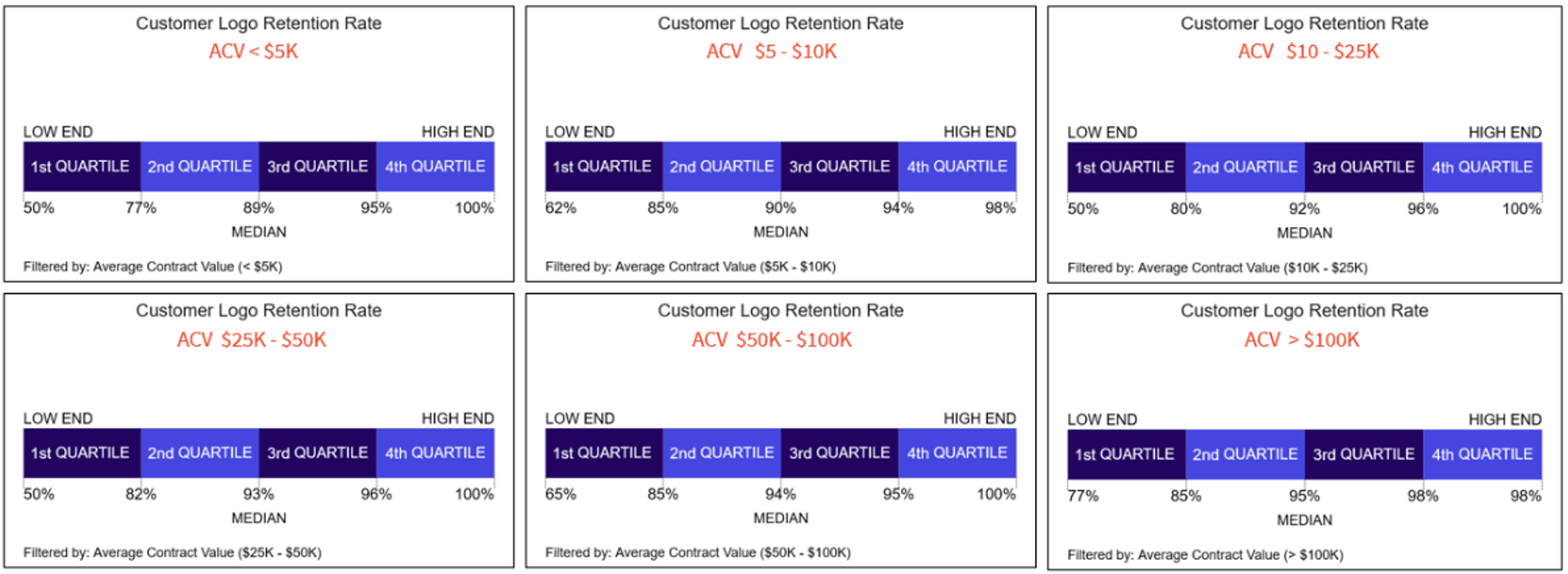
- Segmentation insights: Logo churn analyzed by customer segment (size, industry, acquisition channel, plan tier) reveals which customers fit your product best and where to focus acquisition and retention efforts.
Logo Churn vs. Revenue Churn:
These metrics tell different stories and both are essential:
Logo Churn (customer count-based):
- Measures product-market fit and broad customer satisfaction
- Treats $100 customer same as $10,000 customer
- More sensitive to SMB/small customer problems
- Best for understanding whether product serves the masses
MRR/ARR Churn (revenue-based):
- Measures financial impact of customer loss
- Weighted by customer value
- More sensitive to enterprise/large customer problems
- Best for understanding P&L impact
Critical insight: You can have seemingly acceptable revenue churn (2% monthly MRR churn) but terrible logo churn (8% monthly) if you're losing many small customers while retaining a few large ones. This indicates:
- Poor product-market fit in your core segment
- Over-dependence on a few large accounts (concentration risk)
- Unsustainable growth model (large customers eventually churn too)
Conversely, high logo churn with low revenue churn might indicate:
- Strong enterprise product-market fit, weak SMB fit
- Potential to "graduate" from SMB to enterprise focus
- Need to raise minimum contract sizes or improve SMB onboarding
Important Considerations:
Defining "churned":
- Voluntary churn: Customer actively cancels or chooses not to renew
- Involuntary churn: Account canceled due to payment failure, delinquency, or policy violation
- Track both separately—involuntary churn is often recoverable through payment retry logic or dunning campaigns
Time period selection:
- Monthly: Standard for monthly or annual subscriptions, provides fastest signal
- Quarterly: Useful for annual contracts to smooth volatility
- Annual: Best for multi-year contracts or when measuring mature business health
Cohort analysis:
- Calculate logo churn by acquisition cohort (e.g., customers acquired in Q1 2024) to understand if retention is improving over time
- Newer cohorts should show better retention as you optimize onboarding and product
Seasonal considerations:
- Some businesses have seasonal churn patterns (e.g., fitness apps peak churn in February, tax software churns post-tax season)
- Compare year-over-year, not month-over-month, to account for seasonality

.png)