Annual Recurring Revenue (ARR) is a key financial metric representing the value of a business's repeatable, predictable subscription income normalized over a 12-month period. It quantifies the expected yearly revenue a subscription business, particularly those with contracts of a year or longer, can count on from its current customer base. The metric is calculated by annualizing all active, contractually committed subscriptions, excluding one-time fees, professional services, or variable usage charges. ARR is crucial for long-term forecasting, capital allocation, and business valuation, as it highlights the stability and scale of the subscription revenue stream.
ƒ Sum(Recurring Revenue irrespective of billing interval expressed as an annual value)
If a customer subscribes to a service with a 1-year renewal agreement for $12,000, then Annual Recurring Revenue would be;
ARR = $12,000
If a customer subscribes to a service for $10,000 (with no contract), then Annual Recurring Revenue would be;
ARR = $0
If a customer subscribes to a service with a monthly renewal agreement for $1,000 per month, then Annual Recurring Revenue would be;
ARR = $1,000 * 12 = $12,000
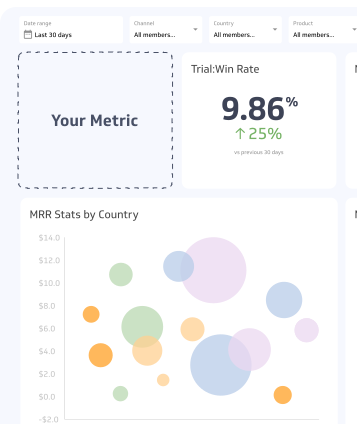
To visualize your Annual Recurring Revenue, you can use a summary chart to display the value and optionally compare it to a previous time period.
Annual Recurring Revenue (ARR) is the North Star metric for many Software-as-a-Service (SaaS) and other subscription businesses that rely on term-based contracts, usually with a minimum term of one year. It provides a standardized, high-level view of a company’s financial health and growth trajectory over the long term. Since ARR focuses exclusively on contracted, recurring fees, it offers a more reliable indicator of future performance than simply looking at total revenue, which can be inflated by non-recurring transactions.
The Strategic Value of ARR
ARR is fundamentally a strategic tool used by executive leadership, boards of directors, and investors for long-range planning and valuation.
-
Long-Term Forecasting and Budgeting: The stability of ARR allows finance teams to create highly accurate 12-month, 3-year, and 5-year financial models. This predictability is essential for making capital-intensive decisions, such as securing new office space, significantly expanding the engineering team, or making strategic acquisitions.
-
Business Valuation and Investment: For venture capitalists and strategic buyers, ARR is the primary determinant of a SaaS company’s valuation. Companies are often valued using an ARR multiple (Valuation ÷ ARR), where high-growth, high-retention businesses command significantly higher multiples. Longer term contracts, where churn is demonstrably lower, signal future financial stability and are highly attractive to investors. A strong ARR trend indicates both product-market fit and a scalable business model.
-
Strategic Segmentation: ARR can be segmented by various factors, such as product line, average contract value (ACV), customer industry, or sales channel. This detailed segmentation helps leadership pinpoint the most profitable and fastest-growing areas of the business, informing sales and marketing strategy. For instance, if ARR is growing quickly in the Enterprise segment but stagnating in the Small Business segment, resources can be strategically reallocated.
ARR vs. MRR: The Key Distinction
While ARR and Monthly Recurring Revenue (MRR) are closely related, each metric serves a different operational purpose.
ARR is best for strategic planning, long-term forecasting, investor communication, and companies with annual or multi-year contracts. It's mostly used where the target market is B2B SaaS, Enterprise software, and preferred if most customer contracts are for 12 months or longer.
MRR is more common for operational management, short-term health checks, tracking the impact of monthly marketing/pricing changes, and companies with monthly contracts. Unlike ARR, target markets here are more likely to be B2C, SMB SaaS, consumption-based models, where customer contracts might be less than 12 months.
The primary difference is their utility: ARR offers the big-picture view, smoothing out the smaller monthly fluctuations in the recurring revenue stream, making it the superior metric for year-over-year growth comparison.
Components of Net New ARR
To understand the health and momentum of the business, leaders track the change in ARR from one period to the next, which is known as Net New ARR or ARR Growth. It captures all revenue movements within the customer base.
-
New ARR (or Gross New ARR): This is the annualized recurring revenue from brand-new customers acquired during the period. It reflects the effectiveness of the sales and marketing efforts.
-
Expansion ARR: Additional recurring revenue gained from existing customers through actions like upgrading to a higher-tier plan, purchasing new add-ons, or increasing the volume of a usage-based subscription. High Expansion ARR is a crucial indicator of customer satisfaction and Net Revenue Retention (NRR) above 100%.
-
Contraction ARR: Lost recurring revenue from existing customers due to downgrades to a cheaper plan or the removal of paid add-ons. This often signals a shift in customer needs or budget constraints.
-
Churn ARR: The total recurring revenue lost from customers who cancel their subscriptions entirely and do not renew their contracts. This is the most direct measure of customer dissatisfaction or failure to deliver promised value.
-
Reactivation ARR (or Restart ARR): Revenue from customers who previously churned but have returned and re-subscribed to the service.
Tracking these components separately allows management to identify whether growth is being driven by landing new customers (New ARR) or by increasing the value of existing customers (Expansion ARR). As companies mature, the proportion of growth driven by Expansion ARR tends to increase.
Best Practices and Exclusions
To ensure ARR is an accurate and trustworthy metric for a business and its investors, specific calculation standards must be maintained.
-
Exclusion of Non-Recurring Revenue: This is the most critical rule. ARR must exclude all one-time fees, such as setup fees, implementation charges, professional services consulting, custom development, and hardware sales.
-
Normalization of Contract Terms: For multi-year contracts, the total contract value (excluding one-time fees) must be divided by the number of years to arrive at the correct annual contribution. For example, a three-year, $150,000 contract contributes $50,000 to ARR each year, not $150,000 in the first year.
-
Inclusion of Recurring Add-ons: Any fixed, recurring fees that the customer is contractually obligated to pay annually, such as ongoing maintenance or technical support fees, should be included. However, variable, usage-based fees (like overage charges or consumption credits) should generally be excluded, as they lack the predictability required of an ARR metric.
-
Focus on Committed Contracts: ARR should only reflect revenue from customers who have a contractually committed term. Revenue should be calculated as if the customer will complete the full term of their agreement.
The failure to adhere to these standards, particularly the inclusion of non-recurring revenue, is the most common error and can severely distort the perceived health and valuation of a subscription business.