A video published on January 1st accumulates 250 hours of watch time in its first month and 150 hours in its second month. Total Video Watch Time after two months = 400 hours. That number tells you about volume; to understand quality, pair it with Average View Duration and Average Percentage Viewed to see what those 400 hours represent relative to audience size and video length.
Video Watch Time
Last updated: Aug 24, 2026
What is Video Watch Time?
Video Watch Time is the total time viewers have spent watching a video or a collection of videos, measured in seconds, minutes, or hours. This metric helps you understand whether your content is holding attention or losing viewers early. High watch time signals that people find the content valuable enough to keep watching, and platforms like YouTube use it as a core ranking signal that directly affects content distribution.
Alternate names: Minutes Watched, Time Spent (Video)Video Watch Time Formula
ƒ Sum(Seconds Watched) OR Sum(Minutes Watched) OR Sum(Hours Watched)
How to calculate Video Watch Time
Start tracking your Video Watch Time data
Use PowerMetrics, modern analytics platform, to monitor your data. Choose a service below to start tracking your Video Watch Time instantly.

How to visualize Video Watch Time?
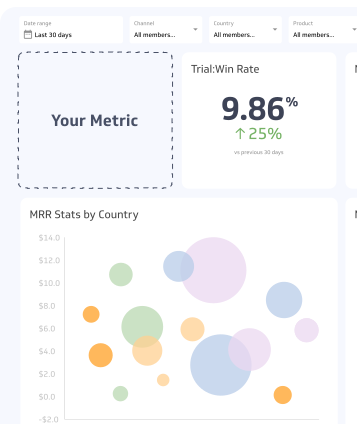
Ideally, you want your Video Watch Time to increase cumulatively over time. A summary chart can help you visualize this trend.
Video Watch Time visualization example

Summary Chart
Here's an example of how to visualize your current Video Watch Time data in comparison to a previous time period or date range.

Video Watch Time
Chart
Measuring Video Watch TimeMore about Video Watch Time
How to interpret Video Watch Time
Watch time is an absolute number, which makes it useful for tracking growth but limited for comparing videos of different lengths or audiences of different sizes.
A short video with 400 hours of watch time from 10,000 viewers may be performing better than a long video with the same total from 1,000 viewers. Context matters. Use watch time alongside these related metrics to get a clearer picture:
Average View Duration: The mean time a single viewer spends watching. Divide total watch time by total views.
Average Percentage Viewed: How far through the video viewers get, on average. Useful for identifying drop-off points.
Minutes per Viewer: Total watch time divided by the number of unique viewers. Shows engagement depth per person.
These metrics together reveal whether your watch time is driven by a large audience watching briefly, or a smaller audience watching thoroughly. Both can be valuable, but they call for different responses.
What drives watch time up or down
Several factors affect how much total time viewers accumulate on your content.
Factors that increase watch time:
Strong openings: Viewers decide within the first few seconds whether to keep watching. A clear, compelling hook reduces early drop-off.
Consistent pacing: Dead air, slow introductions, and repetitive sections push viewers to skip or leave.
Relevant titles and thumbnails: When the title matches what the video delivers, viewers stay longer because expectations are met.
Playlists and series: Grouping related videos encourages auto-play and sequential viewing, compounding total watch time across a session.
Video length matched to topic: Longer videos can accumulate more watch time, but only if the content justifies the length. Padding a five-minute topic into fifteen minutes typically increases drop-off.
Factors that decrease watch time:
Slow starts: Long intros, extended recaps, or delayed value delivery cause viewers to leave before the content begins.
Poor audio or video quality: Technical issues reduce tolerance for content that might otherwise hold attention.
Misleading titles: Clickbait that does not match the content drives fast abandonment and trains the algorithm to distribute the video less.
Watch time and platform algorithms
YouTube treats watch time as one of its most important ranking signals. The platform wants viewers to stay on YouTube, so it favours content that keeps people watching, both within a single video and across a session. A video that generates high watch time is more likely to appear in recommendations and search results.
This creates a meaningful incentive: improving watch time is not just a content quality goal, it is a distribution strategy. Creators and marketers who focus on retention tend to see compounding returns as the algorithm surfaces their content to more viewers.
Other platforms, including LinkedIn Video and Instagram Reels, use similar engagement signals, though the specific weighting varies and is not always disclosed.
Common pitfalls
Treating total watch time as a quality signal in isolation. A viral video with millions of views but a 10% average view duration may have lower quality engagement than a niche video with 500 views and 80% average view duration. Always pair watch time with retention data.
Optimizing for length over substance. Longer videos can accumulate more watch time, but artificially extending content to hit a duration target tends to reduce average view duration and hurt algorithmic performance over time.
Ignoring aggregate watch time across a channel or playlist. Individual video performance matters, but platforms also consider total session time. A library of shorter videos that keeps viewers watching sequentially can outperform a single long video.
How Video Watch Time relates to adjacent metrics
| Metric | Relationship to Video Watch Time |
|---|---|
| Average View Duration | Derived from watch time; shows per-view engagement |
| Average Percentage Viewed | Contextualizes watch time relative to video length |
| View Count | Combined with watch time, indicates audience size vs. depth |
| Subscriber Growth | High watch time often correlates with new subscribers on YouTube |
| Impressions Click-Through Rate | Affects how many views are generated, which scales watch time |
Watch time sits at the intersection of reach and engagement. It grows when more people watch and when those people watch longer. Improving it requires attention to both: bringing in the right audience and giving them content worth finishing.
Video Watch Time Frequently Asked Questions
What is Video Watch Time?
Video Watch Time is the total time viewers have spent watching a video or a collection of videos, measured in seconds, minutes, or hours. It is used to evaluate whether content holds audience attention and is a key ranking signal on platforms like YouTube.
How is Video Watch Time calculated?
Video Watch Time is calculated by summing all the time spent watching across every view: Sum(Seconds Watched), Sum(Minutes Watched), or Sum(Hours Watched), depending on the platform's reporting unit.
Why does YouTube prioritize watch time in its algorithm?
YouTube wants viewers to spend as much time as possible on its platform, so it favours videos that keep people watching. Higher watch time signals valuable content, which the algorithm rewards with more recommendations and better search placement.
What is the difference between Video Watch Time and Average View Duration?
Video Watch Time is the total accumulated time watched across all views. Average View Duration is the mean time a single viewer spends watching, calculated by dividing total watch time by total views. Watch time measures volume; Average View Duration measures per-view engagement quality.
How can I improve Video Watch Time?
Focus on strong openings to reduce early drop-off, match titles and thumbnails to the actual content, maintain consistent pacing, and group related videos into playlists to encourage sequential viewing. Avoid padding content beyond what the topic warrants.
Recommended resources related to Video Watch Time
Learn more about YouTube's Watch Time report.Contributor