MQL (Marketing Qualified Lead) to SQL (Sales Qualified Lead) conversion rate is the percentage of MQLs that are converted to an SQL. An MQL is a lead that marketing believes meets the criteria of a qualified prospect, and an SQL is a lead that sales has independently qualified and believes meets the criteria of a qualified prospect.
To calculate MQL to SQL conversion rate, consider the following scenario: at the end of the month, your website generates 1,000 MQLs. Out of these, 350 respond to your sales team's initial outreach efforts and are converted to SQLs. So your MQL to SQL Conversion Rate for this month would be 350 / 1,000 which is 35%.
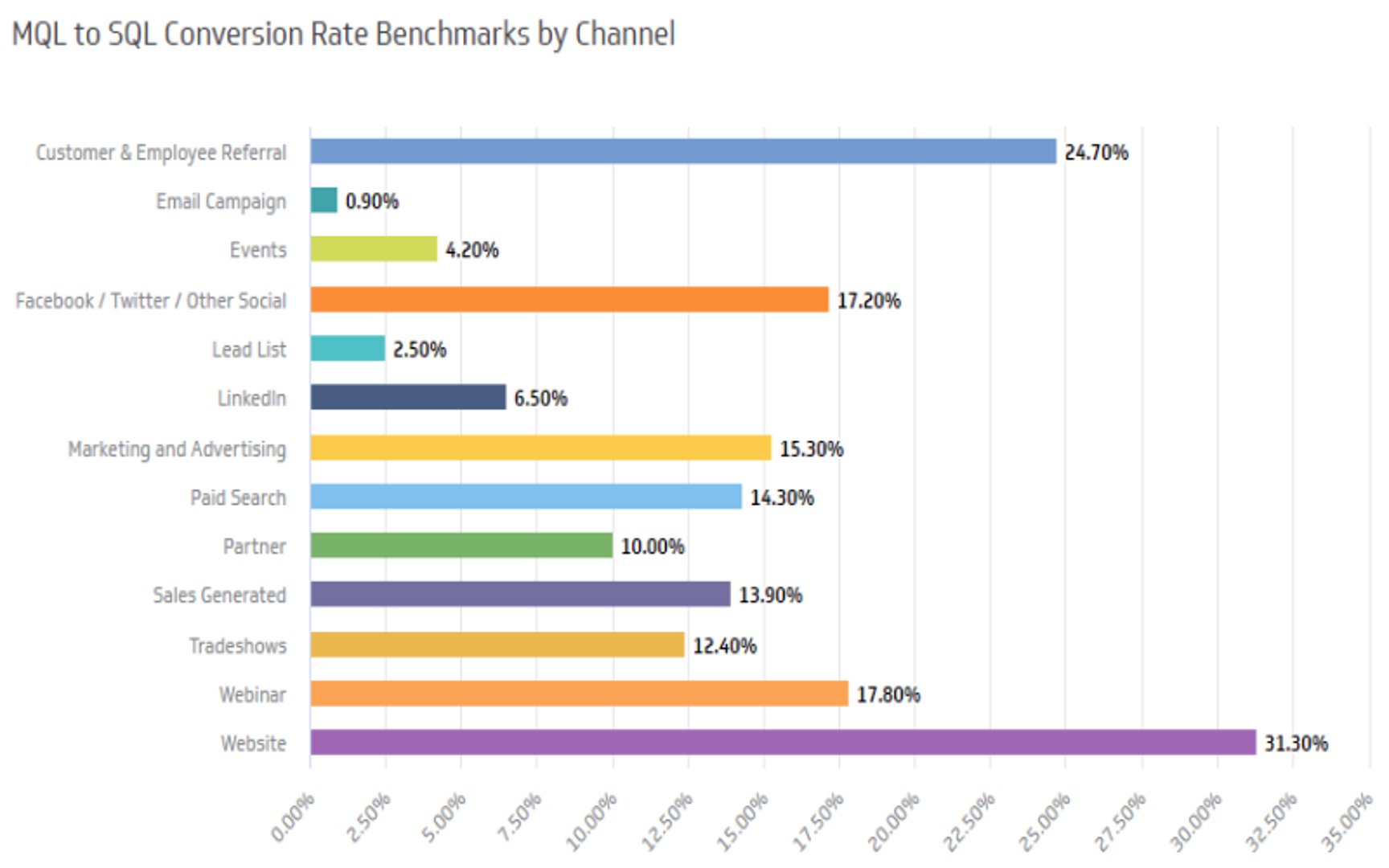
A good benchmark for MQL to SQL Conversion Rate is 13%, across a wide range of industries and channels. Websites and customer/employee referrals in particular have a very high MQL to SQL conversion rate.
The best way to visualize your MQL to SQL Conversion Rate is either with a summary chart or a line graph. These data visualizations are the best way to compare your conversion rate with another time period or observe trends over time. You can then use this information to improve your conversion. Additionally, segment your conversion rate by channel to understand which conversion channel works best for your business.
In many organizations, the MQL to SQL conversion point in the customer lifecycle is a handoff point where marketing’s one-to-many communication is transferred to sales’ one-to-one communication. The criteria of both an MQL and an SQL is determined by the team itself. Common criteria for an MQL can be meeting a lead score threshold, direct engagement with a marketing program, or by responding to a campaign. For an SQL, the criteria may be as simple as passing internal sales criteria such as having a corporate email, a valid LinkedIn profile, or by responding to an initial sales outreach.
The conversion rate from MQL to SQL depends on the definitions used by your team. If you take the HubSpot lifecycle model, the SQL stage is the first touchpoint for sales. In this case, you’d aim to have a high conversion rate as this would indicate a high degree of alignment between marketing demand gen initiatives and sales strategy.
MQL to SQL conversion rate can be calculated by looking at the number of MQLs generated in a month and comparing to the number of SQLs created. The purpose of an MQL is to provide sales with prospects who are ready for an immediate follow up, so there is typically no need to offset the date an SQL is generated.