A software company reviews its annual income statement. General and administrative expenses total $99,284; sales and marketing expenses total $334,319; research and development costs total $148,159. Adding these together gives total operating expenses of $581,762. Subtracting this figure from gross profit produces the company's operating income — the profit generated from core operations before interest and taxes.
Operating Expenses (OPEX)
Last updated: Jun 26, 2026
What is Operating Expenses?
Operating expenses (OPEX) are the costs a business incurs through normal operations that are not directly tied to producing goods or services. Per QuickBooks, OPEX represents the Expenses section on the Profit & Loss statement, excluding cost of goods sold (COGS) and other expenses. Common examples include sales and marketing costs, administrative salaries, and research and development expenditures.
Alternate names: Operational Expenditures, Non-Manufacturing CostsOperating Expenses Formula
ƒ Sum(Operating Expenses)
How to calculate Operating Expenses
Start tracking your Operating Expenses data
Use PowerMetrics, modern analytics platform, to monitor your data. Choose a service below to start tracking your Operating Expenses instantly.

How to visualize Operating Expenses?
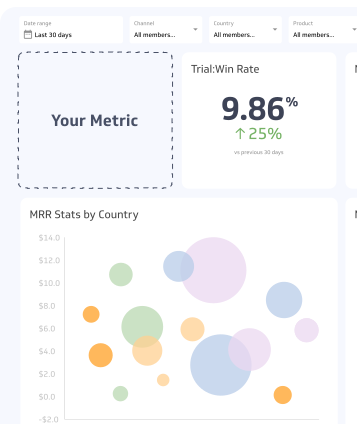
It is sufficient to visualize your Operating Expenses as a summary chart. This type of chart compares your current value to a previous time period.
Operating Expenses visualization example

Summary Chart
Here's an example of how to visualize your current Operating Expenses data in comparison to a previous time period or date range.

Operating Expenses
Chart
Measuring Operating ExpensesMore about Operating Expenses
Why operating expenses matter
Operating expenses directly determine operating income. A business with high OPEX relative to revenue may struggle to reach profitability, even with strong sales.
One of management's core responsibilities is finding the right balance: reducing operating expenses enough to improve efficiency, without cutting so deep that the business loses its ability to compete or grow.
That balance shifts depending on business stage:
- Growth-stage companies often run high OPEX intentionally, investing heavily in sales, marketing, and R&D to capture market share. OPEX may grow faster than revenue for several years.
- Mature companies typically aim to hold OPEX growth below revenue growth, expanding operating margins over time.
Tracking OPEX in isolation can mislead. A rising OPEX number isn't inherently bad — context matters. The trend relative to revenue and business stage is what makes the number meaningful.
Fixed vs. variable operating expenses
Not all operating expenses behave the same way as revenue changes.
Fixed operating expenses remain relatively stable regardless of output — office rent, executive salaries, and software subscriptions fall into this category. These costs create a baseline that the business must cover before generating profit.
Variable operating expenses scale with business activity — sales commissions, performance marketing spend, and some R&D costs rise and fall with revenue or headcount.
Understanding this split helps management make better decisions under pressure. When revenue drops, cutting variable OPEX is faster and less disruptive than cutting fixed costs.
Operating expenses vs. capital expenditures
Operating expenses are distinct from capital expenditures (CapEx). OPEX covers recurring costs consumed within the accounting period — salaries, rent, utilities. CapEx covers investments in long-term assets — equipment, property, or infrastructure — that depreciate over time.
This distinction matters for financial reporting and tax treatment. OPEX is fully deducted in the period it occurs; CapEx is capitalized and depreciated over the asset's useful life.
Some spending decisions involve a genuine choice between OPEX and CapEx. For example, a company might lease software (OPEX) or build it internally (CapEx). The right choice depends on cash flow, tax strategy, and flexibility needs.
Common challenges when tracking operating expenses
Misclassifying COGS as OPEX — Direct production costs belong in COGS, not operating expenses. Mixing the two distorts gross margin and operating margin, making it harder to diagnose where profitability problems originate.
Ignoring context — Comparing OPEX across companies or periods without accounting for business stage, industry, or growth strategy leads to flawed conclusions. A high OPEX ratio at a growth-stage company is not the same signal as the same ratio at a mature firm.
Treating all cuts equally — Reducing OPEX improves short-term margins, but cuts to R&D or customer acquisition can damage long-term revenue. Effective management distinguishes between efficiency gains and value destruction.
Inconsistent categorization — Without a consistent chart of accounts, the same type of expense may be recorded differently across periods or departments, making trend analysis unreliable.