A retail store closes out a trading day with $10,000 in new sales (credits) and $1,500 in refunds (debits). The revenue account balance for the day is $10,000 ? $1,500 = $8,500 net credit balance. This confirms the store recognized $8,500 in net revenue — a positive credit balance is the expected outcome for a revenue account.
Account Balance
Last updated: Jun 19, 2026
What is Account Balance?
Account Balance is the net difference between all credits and all debits recorded in a specific account on a company's general ledger. When credits exceed debits, the account carries a net credit balance. When debits exceed credits, it carries a net debit balance. Tracking account balances supports financial statement preparation, tax compliance, and business trend analysis.
Alternate names: Balance, General Ledger Account BalanceAccount Balance Formula
ƒ Sum(Account Credits - Account Debits)
ƒ Sum(Account Debits - Account Credits)
How to calculate Account Balance
Start tracking your Account Balance data
Build and track this metric in PowerMetrics, a modern analytics platform that lets you define metrics and connect your own data.
Get PowerMetrics Free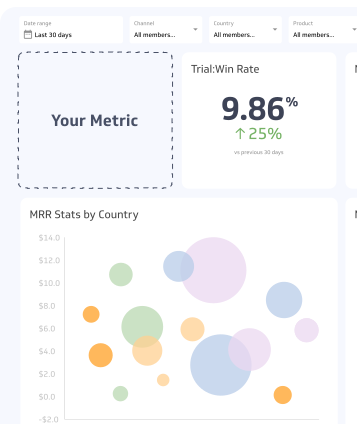
How to visualize Account Balance?
Visualize your Account Balance by using a summary chart to display the current value, optionally comparing to a previous time period.
Account Balance visualization example

Summary Chart
Here's an example of how to visualize your current Account Balance data in comparison to a previous time period or date range.

Account Balance
Chart
Measuring Account BalanceMore about Account Balance
A general ledger records, stores, and summarizes every transaction across five core account types: assets, liabilities, owner's equity, revenue, and expenses.
Each transaction is entered as both a debit and a credit, keeping the ledger balanced at all times. This is the foundation of double-entry accounting. As a result, the following equations always hold true:
Assets = Liabilities + Owner's Equity
Net Income = Revenue ? Expenses
Why account balance matters
Tracking account balances across the general ledger supports several critical business functions.
Financial statement preparation: Balance sheet and income statement figures are drawn directly from general ledger account balances. Accurate balances are a prerequisite for accurate reporting.
Tax compliance and regulatory filing: Historical account records provide the audit trail needed to file taxes correctly and satisfy government reporting requirements.
Business trend analysis: Comparing account balances across periods reveals patterns in revenue, expenses, and asset accumulation. These patterns inform budgeting and forecasting decisions.
How account balances work in practice
Normal balance by account type: Each account type has an expected normal balance — the side (debit or credit) that increases it. Assets and expenses carry normal debit balances; liabilities, equity, and revenue carry normal credit balances. A balance on the opposite side signals an error or an unusual transaction worth investigating.
Period-end closing: At the end of each accounting period, temporary accounts (revenue and expenses) are closed out to retained earnings, resetting their balances to zero. Permanent accounts (assets, liabilities, equity) carry their balances forward into the next period.
Reconciliation: Account balances should be reconciled regularly against external statements — bank records, vendor invoices, and customer accounts — to catch discrepancies early. Unreconciled balances are a common source of financial reporting errors.
Materiality: Not all balance discrepancies require the same level of attention. Finance teams typically set materiality thresholds to focus review effort on accounts where errors would meaningfully affect reported results.
Recommended resources related to Account Balance
How to calculate credits and debits in a general ledger.Contributors

.jpg)